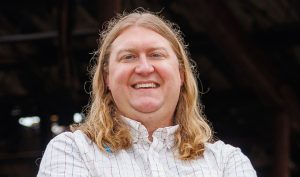
Alumnus Robert Reid Jr. has stayed focused on patient care — even when he became the patient.
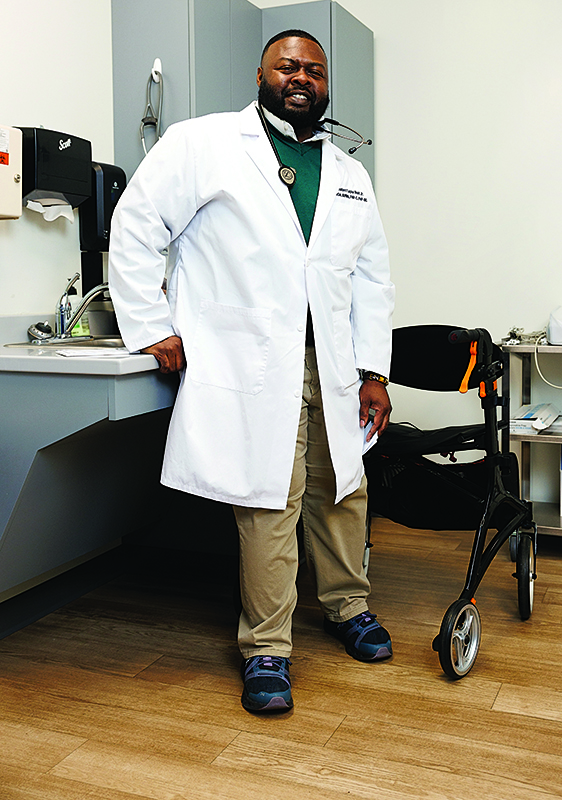
Around 7 a.m. each weekday, Robert Reid Jr. ADN ’02, BSN ’05 arrives for work at an outpatient clinic near Charlotte, North Carolina. The nurse practitioner typically sees his first patient 30 minutes later, but his preparations for that visit have started many hours earlier.
“Typically, the night before, I’m looking at my charts,” Reid says. “I’m looking at my people, going through their medical records. I believe building a rapport is very important to calm fears and to let that person know we’re on the same level.”
Reid works to create that personal relationship with each patient, allowing them a voice in their care. His approach is rooted in his experiences with nursing as both a recipient of care and the child of a terminally ill parent.
When Reid was 14, his father was hospitalized for colon cancer. Reid spent many days visiting him and saw firsthand how the nurses advocated and cared for his father.
Observing the healthcare system from inside left an impression on him: “I saw how much difference competence, consistency and presence made — not just kindness but knowing what you’re doing and showing up when it counts,” Reid says. “That stuck with me.”
A defining moment came when Reid took a career assessment in his junior year of high school. To his disbelief, it suggested nursing would be a good path. He admits he had other ideas about success then, and had to get past his assumptions about nursing and look at the work itself. He found the profession aligned with him in many ways.
“It’s hands-on, structured, and purpose-driven, but it also requires judgment, discipline, and accountability,” he says. “That combination mattered to me.”
Reid, a native of Lancaster, planned to study nursing at another college but discovered the program wasn’t offered there. Because he had family in Greer, his research led him to USC Upstate, then known as USC Spartanburg. The quality of the nursing school combined with proximity to family sealed his choice.
Once enrolled, he quickly learned the commitment needed to succeed. He adjusted his schedule to allow for hours of study in the library. But he still found time to get involved in clubs and activities. Looking back, he credits staff mentors, including those in Student Life, for helping him develop career skills, such as interview etiquette and how to dress professionally.
One mentor who was particularly impactful was gospel choir director Warren Carson. “He was very instrumental in not only my life, but I feel like a number of African American students’ lives because he expected nothing less than greatness,” Reid says. Whenever he saw Carson, Reid felt assured that someone was looking out for him.
After earning his ADN, Reid started at Spartanburg Regional feeling “significantly prepared” for the work – something his preceptor remarked upon as well. He was eager to keep developing his skills, so he soon returned to Upstate for the RN-BSN program.
He went into travel nursing after graduation, then moved to North Carolina to be closer to family. His career path included serving as a clinical instructor, earning his master’s degree, and then doing nursing informatics. But he missed working with patients, so he enrolled in a nurse practitioner program at Duke University in early 2019.
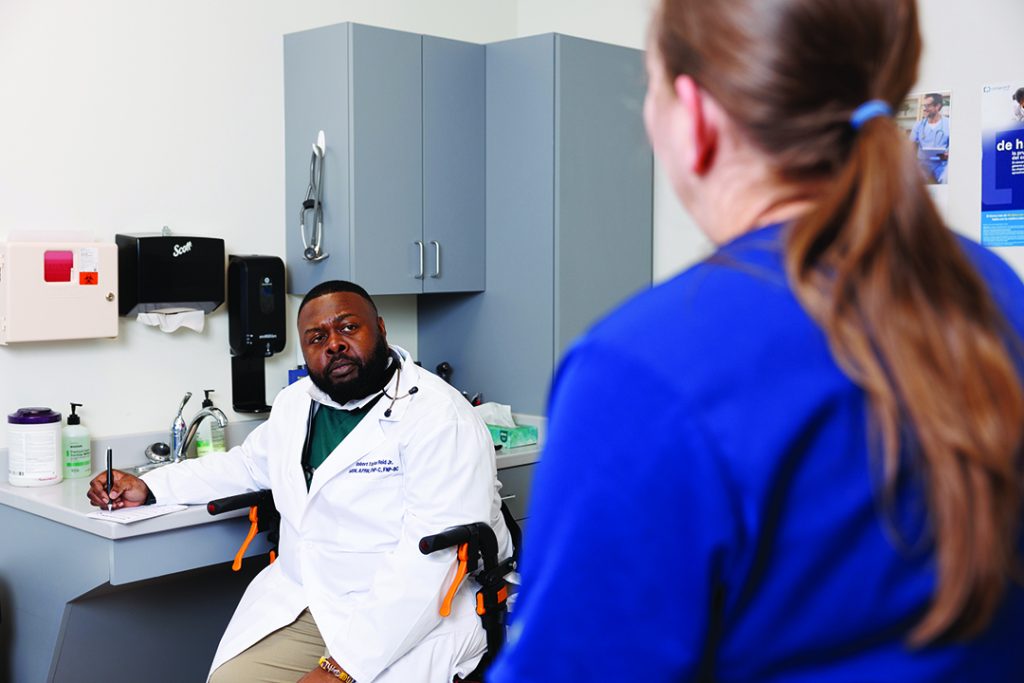
Reid had completed two semesters of the program when he suddenly became deathly ill. He was rushed to an emergency room, non-responsive and paralyzed from the waist down, and placed on a ventilator.
“I woke up 20 days later, like, ‘What is going on?’” Reid recalls.
Reid was diagnosed with Guillain-Barré syndrome, an autoimmune disorder that attacks the body’s motor and sensory systems. The memory of being told he would never walk again still makes him emotional.
“I was like, ‘What do you mean? I’m at the height of my life. … I’m at the peak of the mountain,’” he says.
It took Reid more than three months to regain some limited mobility. He used a power chair to get around and had to put his education on hold. But by fall 2020, he decided he was going back to school. He remembers only being able to walk around 5 feet.
With the help of his advisor, Reid started online classes — one course at a time, as the condition had affected his memory. Eventually, he transitioned to a rollator walker and was able to return to his patients.
The experience deepened his understanding of his patients’ challenges and made him mentally and emotionally stronger: “It taught me self-reflection, more self-actualization, more empathy.”
Reid earned his degree in May 2023 and completed his residency at the Durham VA the following year. He is now pursing a Doctor of Nursing Practice degree at UNC Greensboro and focusing on preventative health, a personal passion of his.
He also feels strongly about mentoring others, given the impact mentoring had on him. Reid serves as mentorship chair for the newly formed Black Alumni Council and plans to connect students with fellow alumni who can guide them. He hopes to start with first-generation students and others in need of extra support.
And he always wants to help future nurses: “Anybody who wants to be in the medical field, nursing, if I can get in contact with them, I’m going to help guide their path, I’m going to help mentor them,” Reid says.