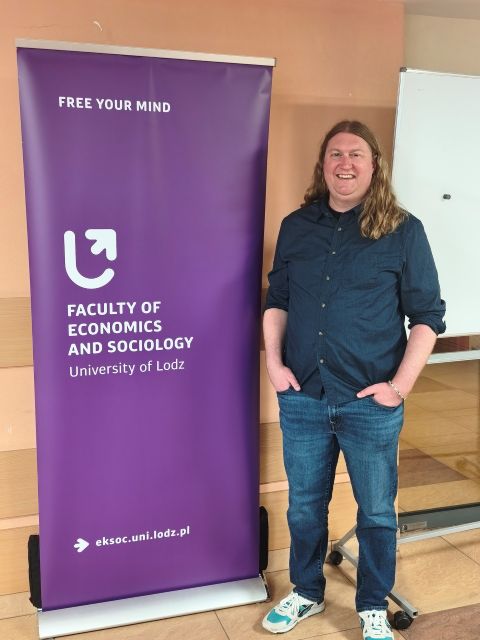
Sociology Professor Colby King spent the fall semester teaching in Poland all while holding his usual classes on the USC Upstate campus.
King was invited to teach upper-level sociology students at the University of Łόdź as part of a fellowship program there that seeks to build global collaboration among scholars and bring new perspectives to students. Classes are taught in English to help the students practice their language skills.
Because of the difference in academic calendars between Łόdź and Upstate, King taught the classes virtually. It was the first time he’d taught exclusively sociology majors, since his classes at Upstate attract students from many different majors.
King focused his sessions on some of his favorite topics in sociology, including social class and social inequality and race and racial inequality. He also included new research he is working on about the sociology of art and new technologies.
While the Polish students were familiar with the general concepts, they were able to do a deep dive during class discussions, King says. “They have assumptions and stereotypes about what social class identity really looks like in the U.S., or how racial inequality actually functions,” he explains. “I think they were happy to get more perspective and have some of those issues demystified a bit.”
King also had the Łόdź students do presentations about one of the topics. One group’s was particularly strong, so King invited them to present virtually to his community development studies class at Upstate. Two students with shared career interests even connected. “Both Upstate and Polish students are very concerned about finding a job where they can work on improving and strengthening their community,” he notes.
While the teaching part of his fellowship is now complete, King will be flying to Poland in May to meet with sociology faculty there about a shared research project comparing career trajectories of first-generation and non-first-generation academics in Europe. He may do a few guest lectures as well and plans to meet with some of the students he taught in the fall.
“Connecting the students between the institutions has been fun,” King says. “The people I’ve connected with are all interesting people doing interesting work and I’m excited to work with them.”