How USC Upstate is preparing nursing graduates to serve the state’s rural patients.
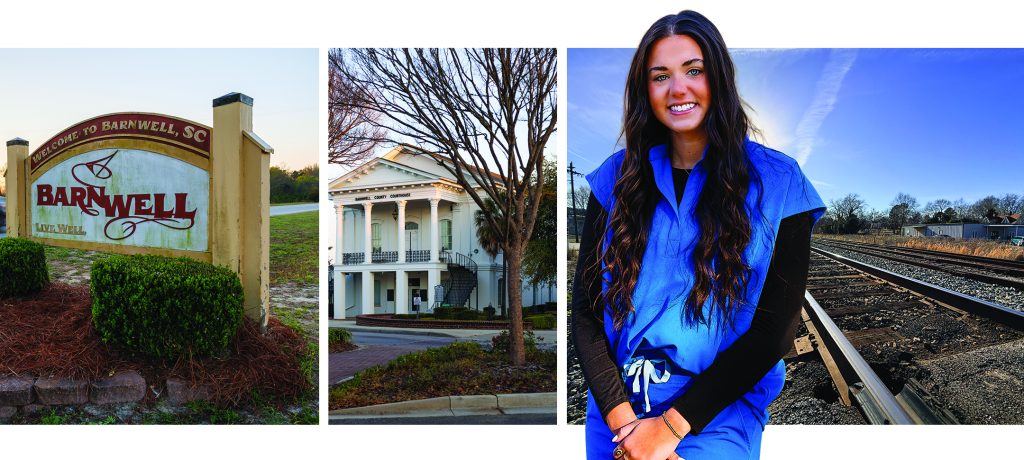
It’s a familiar sight for Taylor Williams ’24: very sick patients arriving at the MUSC Orangeburg emergency room after traveling an hour or more to get to the hospital. Because of the distance, they have often put off seeking care earlier and have waited until their symptoms have worsened.
“A lot of patients don’t have ways to get to appointments,” says Williams, an intensive care unit nurse. “So a lot of times they’ll come in because somebody went to go do safety checks on them at home and found them down or found them unresponsive, things like that.”
As South Carolina’s shortage of medical professionals continues to grow, the impact is being felt most acutely in rural areas. All but five of the state’s 46 counties are designated health professional shortage areas – places with at least 3,500 patients for every one provider, according to the nonprofit Cicero Institute.
Of particular concern in South Carolina is the anticipated shortfall of nurses. The state is among those expected to experience the highest projected shortages of RNs by 2038 and data from the South Carolina Office for Healthcare Workforce show rural areas are affected disproportionately.
A deeper look
At USC Upstate’s Mary Black College of Nursing, faculty recognized the need to place additional focus on this problem. With help from a grant four years ago, the nursing college launched a new rural nursing course to examine the health issues that have a greater impact on rural versus urban populations.
“You typically see a higher rate or incidence of cancer, diabetes, high blood pressure, high cholesterol, heart disease,” explains Felicia Jenkins, associate dean of the nursing college. “A lot of that circles back to social determinants of health – access to care, providers not being available in those rural communities.” Specialty care is almost nonexistent.
These issues have long been part of the nursing curriculum for upper-level students, Jenkins says, but generally within a larger context – community and public health, for example. The dedicated rural nursing course allows for a more in-depth exploration of the subject.
One of the class assignments asks students to focus on a rural community and identify a health issue there, such as heart disease or diabetes. Students then look into what resources are available in the community to address that issue. If there are none, they search for the closest available services and what factors might hinder patients from accessing them.
“Students who work in rural areas, and I think nurses in general, we always have to adapt, we have to be creative,” Jenkins says.
Since it was first offered in fall 2022, the rural nursing course has drawn great interest. It was initially limited to upper-level scholarship students but now is available to students at any level. Jenkins estimates nearly 300 students will have taken the course by the end of this academic year.
Even if most of these students will never practice in a rural setting, they likely will still encounter patients from those communities, Jenkins notes. “Patients may have to travel for an hour, an hour and a half, to get to the closest hospital,” she says, which in the Upstate could be in the cities of Spartanburg or Greenville. “So even though nurses may not always be in those communities, they still may be caring for those populations.”
‘Giving back to my people’
Those who do choose to work in a rural area often have personal reasons for doing so. Williams, a native of Barnwell, South Carolina, commutes an hour to her job at MUSC Orangeburg and feels a strong commitment to local residents.
“A lot of people from my hometown come here for health care, and I honestly feel like it’s just giving back to my people,” she says. “They don’t have anybody else, and if I can help them in some type of way – I mean, that’s my community.”
The work is challenging. Many of the patients who come in suffer from the same three issues: diabetes, heart problems and COPD. “We call it the Orangeburg trifecta,” Williams says. Resources are tight and with a shortage of nurses, there are a limited number of beds available for patients. The emergency room is frequently crowded as a result.
But Williams feels her experiences have made her a better nurse. Out of necessity, she’s taken on duties outside the ICU. She’s been a charge and rapid response nurse, assisted doctors and learned different procedures – things she likely wouldn’t have had an opportunity to do at a larger well-staffed hospital.
“I feel like that has really helped my critical thinking skills, because I’ve learned so much about nursing,” she says. “So I’m very thankful for that.”
And because the staff is small, it’s very much a family. Williams knows the doctors by name and they know her, so when she asks them to check on a patient, they know she has a good reason for it.
“I love the people that I work with, the incredible care here, and we’re very tight,” she says. “So that’s why I stay, because even if I have a bad day, I know that I have people here who can help me get through it.”
Getting creative
Williams’ experiences reflect those of Mehgan Carter MSN ’24, an instructor and success coach at the nursing college. Carter, who is teaching the rural nursing course this spring, grew up in Colleton County and started her nursing career there. She vividly recalls her first shift as a medical-surgical nurse, when she cared for patients who spanned the life cycle – from pregnancy to end of life.
“You have such a blend, because there just aren’t quite as many resources or places to go,” she says.
That means the emergency room sometimes becomes the de facto primary care office for patients. Carter recalls seeing some patients on a semi-regular basis in the ER who didn’t have access to a primary care provider, either due to distance or affordability. In the med-surg unit, it wasn’t uncommon to treat patients who hadn’t been able to access or pay for needed medication or get preventative care.
“With rural health, it’s the place where innovation happens out of necessity,” Carter notes. “That is true for both the health care workers and health care setting, but also for the patients. I think patients try to be innovative with how they take care of themselves. And sometimes that works out well, sometimes it doesn’t.”
Healing care
Hospitals aren’t the only health facilities in short supply in rural areas. Most of South Carolina’s VA clinics or medical centers are located near large population centers in the Upstate, Midlands, and Lowcountry. The locations reflect where the vast majority of the state’s more than 386,000 veterans live, according to data from the U.S. Department of Veterans Affairs.
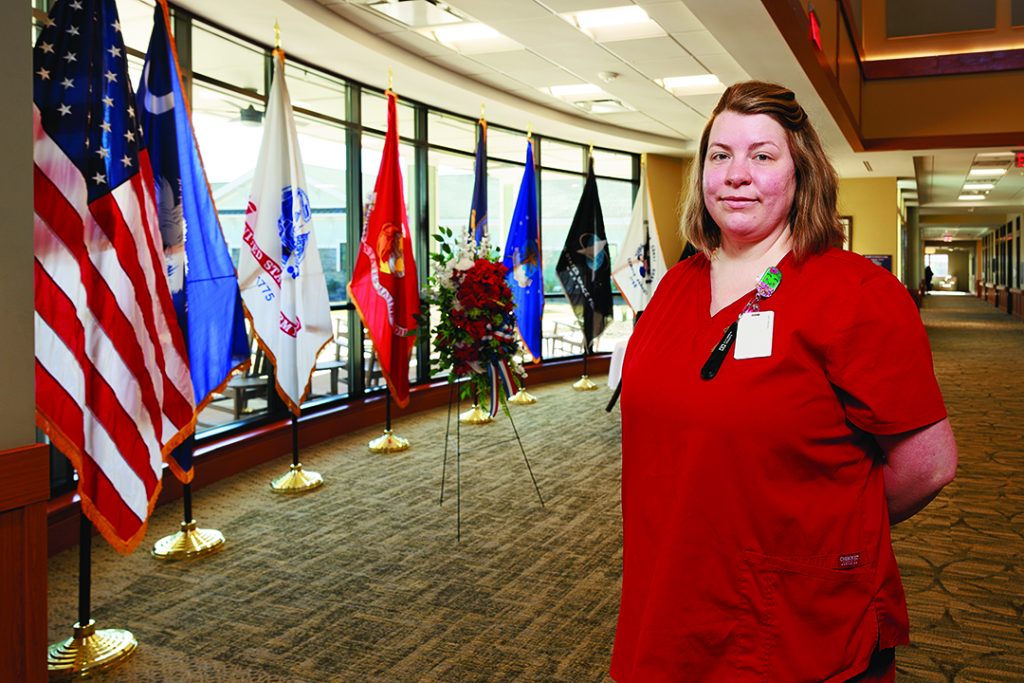
But there are fewer options for veterans living in less populated counties of the state. Kayla Marsden ’24 is a quality assurance and performance improvement nurse at Palmetto Patriots Home, a residential care facility for veterans in Gaffney. The home, which opened in 2022, currently serves veterans whose ages range from 41 to 103. All 104 of its private rooms are occupied, with a waiting list of 150.
The facility provides the kind of specialized care veterans might not find in a regular nursing home. That includes mental health care for such issues as PTSD, anxiety and depression, Marsden says. Because specialists are hard to find nearby, physicians travel from Greenville to visit residents weekly and collaborate with staff and family members on a holistic approach to care.
Working as an interdisciplinary team creates a strong family-like bond, Marsden says. “The doctors will really listen to us, because we’re there every single day with these residents,” she notes. “And so when we are like, ‘Hey, something’s wrong with this person, they’re not themselves,’ they truly do listen to us and support us in that role.”
As is the case at many residential care facilities, finding and retaining good nurses is a challenge, Marsden says, but serving veterans is deeply rewarding work. Because many need care related to their military service, “I want our residents to have the best life that they can have.”
The bigger picture
Carter stresses to her students that the ability to make a difference in the lives of the people among whom you live is one of the rewards of working at a rural facility. “When you live and work in a rural community, you’re serving a population of people that you see at the grocery store, the people that you go to church with, the people that you go to school with,” she observes.
Carter notes that with many job opportunities available for nursing graduates, students may not immediately consider working in a rural area. But she believes the awareness they’ve gained in school of the social determinants of health will serve them well in any setting. Nurses who think about health holistically can help treat not just a patient’s immediate issue, but other factors that may have contributed to it.
“How can we take this patient – who they are, the community that they live in, their socioeconomic status, education – how can we take all of those different aspects into mind to better serve them so that when they leave, they can not only leave healthier, but stay healthier,” she says.