AI tools are giving faculty new ways to help students learn.
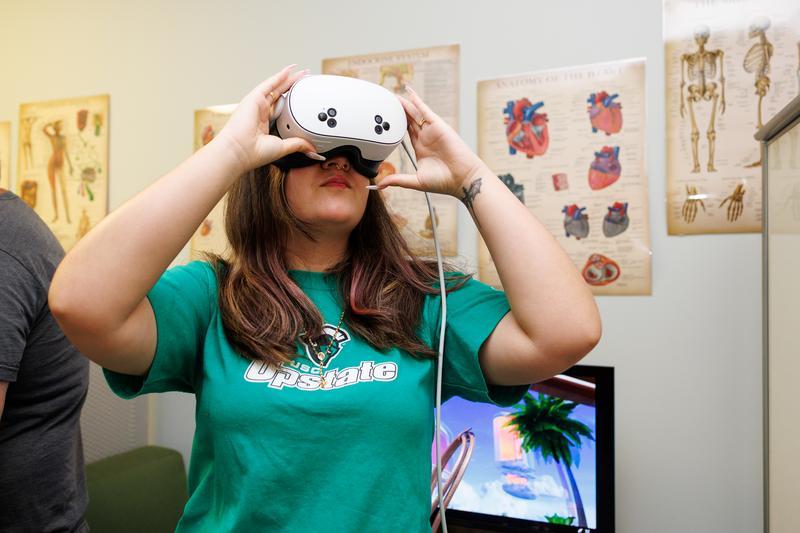
The office of biology instructor Akash Garg is well stocked with all the models you’d expect to find in an anatomy and physiology class. Muscles, skulls and cells crowd together on the shelves with essential organs and bones. During exam times, these models are in high demand, as students take turns studying with them.
But with new virtual tools created by Garg, students can now access 3D versions right from their phones or with VR headsets.
While data is limited, recent surveys suggest more that 60% of faculty globally are using AI in moderation as a teaching tool. At Upstate, faculty have been experimenting with both simple and complex uses of the technology to enhance student learning.
Insides job
Garg’s project grew out of a need to improve retention and pass rates in the anatomy and physiology course. The first-semester class is required for freshman nursing students and is one of the most challenging. Garg wondered how he could boost student outcomes and sharpen study skills.
“Education has to match the student,” Garg says. Creating tools that that use platforms familiar to students seemed like the obvious place to start. Last year he created a digital catalog of every model in the lab, painstakingly photographing every piece with his cell phone and stitching the photos together.
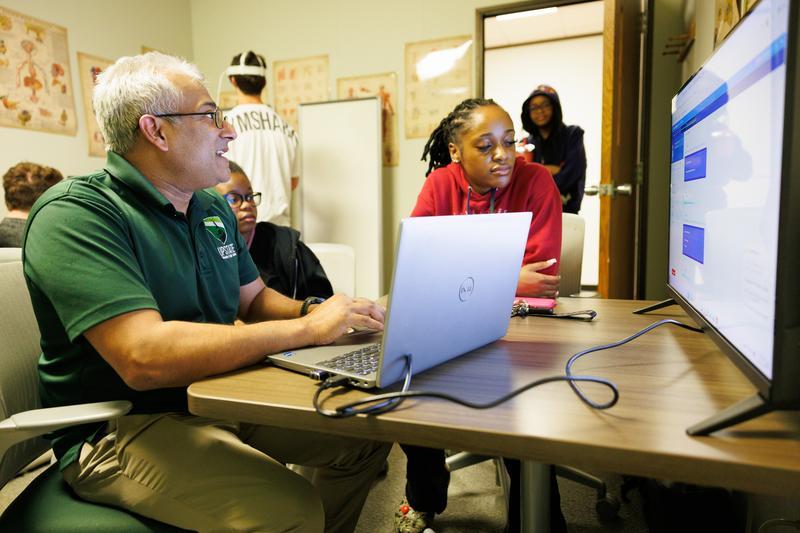
The end result was an online catalog of more than 122 models that students can pull up on their phones or laptops at any time wherever they are. Not only has that relieved competition during exam time for the limited number of physical models, but it’s an affordable solution for the university, since buying more models would cost thousands of dollars.
Even better, the digital format allows students to examine the model in minute detail, rotating the image to look at each labeled area. “The biggest positive I’ve heard is, ‘I can zoom in so much closer than even holding the model,’” Garg says. “The manipulation in space is so much cleaner.”
The models aren’t limited to a flat screen, either. Students who visit the lab can don VR goggles and move the images around as if they were holding them. Garg also created a QR code that students can scan that will bring the model up in augmented reality so it can be moved by hand – similar to the “see it in your space” option that some online retailers offer shoppers.
Garg didn’t stop at virtual models, though. He created a study shell online that included the models, AI chatbots and study guides, organized by class session so students could easily find resources and review the topics they covered. The chatbots are tailored to use only course material when answering students’ questions, to ensure responses are accurate.
The work has paid off. Although the data is limited to one semester, pass rates went up 12% for the first of the two-course series, which Garg considers an excellent start. He’s also exploring other fun learning aids to help students. “Is it the same thing as class? No, it’s supplemental, very much so,” he says. “And that’s what it’s supposed to be.”
Health care on call
That distinction is especially important in nursing, where clinical training is the gold standard even as AI simulation tools become more sophisticated. Cat Aho and Brandon Burnett, who teach medical-surgical classes for upper-level nursing students, began experimenting with virtual reality two years ago in limited circumstances.
“Nothing replaces being bedside, but it gives us a really good flexibility to allow students to ‘be at the bedside’ without actually having to be in the hospital,” particularly when winter weather forces students to miss hours, Aho explains.
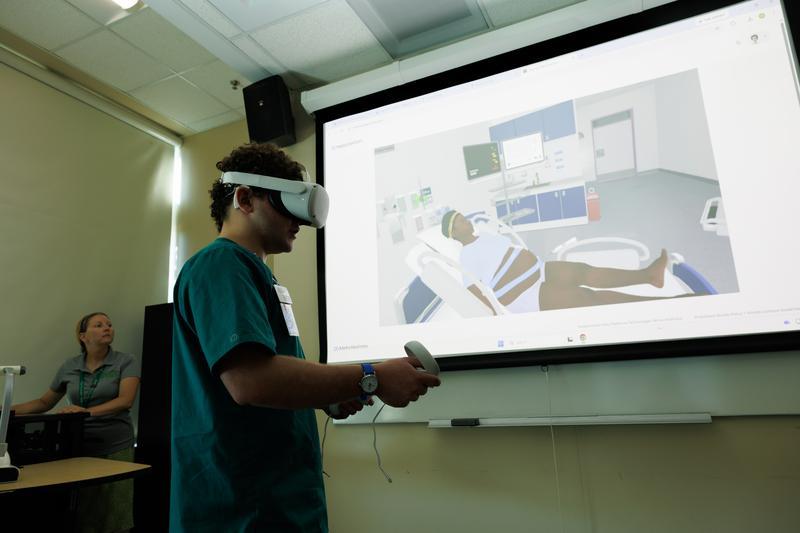
Using VR headsets, students can do rounds in a virtual hospital and put their skills to the test. They can check blood pressure, IVs and temperatures and administer medication. The patient also interacts with them, answering standard assessment questions such as pain level.
Because only one student at a time can wear the headset, images are projected onto a screen so small teams of students can observe. Those who are not wearing the headset can offer feedback and suggestions to the one who is, helping to reinforce lessons on patient protocol and assessment, Aho says.
“It’s a fun, interactive way for them to get additional exposure without having to just do case studies,” she notes.
It also helps students gain confidence. Burnett says nurses know how important it is to establish rapport with a patient the moment they enter a hospital room, but it takes practice. “Not every student is going to walk in feeling, ‘I’ve got this,’” he notes. “So they like the idea they can practice asking questions to the VR patient.”
Burnett sees other areas where a virtual simulation could one day help students, especially mental health, which often involves difficult patient conversations. While he emphasizes clinicals will always provide students’ most important training, virtual reality can offer them a way to keep honing their skills.
On the case
For her senior seminar in criminal justice, professor Michele Covington is giving her students access to an AI-powered tool that could become commonplace in law enforcement investigations.
TimePilot, which complies with federal data security rules about investigations, allows certified users to upload case files that can then be queried. USC Upstate is the first university to partner with Tranquility AI, the platform’s developer, to integrate the technology into a criminal justice class.
“I think it’s a good example of how you can carefully use new technology,” Covington says. “AI isn’t for everything and in some ways it’s very dangerous. But if you are being thoughtful and strategic, you can really use it to your advantage.”
Covington’s students will be working with a real cold case file from the Spartanburg Police Department. The homicide is from many years ago, so a lot of the people involved in the investigation are now dead, Covington says. While that means the odds of finding something new in the file are slim, it’s an opportunity for students to examine how the investigation was conducted then and how it might be done differently today.
“The bigger picture is how do we use tools in a way that makes sense, that is practical, that is secure, that is ethical, and where we’re not sacrificing the really important thought processes and critical thinking that we are already doing.”
Covington will have sole query access to the file, as her students lack the required security training to use TimePilot directly. However, they will be able to view the complete file and provide her with questions she can input into the platform.
Before using TimePilot, Covington will have her students go through the same processes they always follow when looking at a case. Case files usually contain many documents and all of them have to be reviewed. “There’s only one way to get all of that information in your head and start putting it together, and that’s really to go through it piece by piece and word by word,” Covington says.
Once they’re familiar with the details, students start organizing the information and looking for patterns. TimePilot can help at this stage by answering follow-up questions or locating details that a student may be having trouble remembering. It can even help decipher the messy handwriting that is common in old files.
The technology is so new that most law enforcement agencies in the Upstate don’t have it yet. But Convington expects that will change as AI tools become more integrated into the workplace. Upstate students therefore are not only getting a head start on learning an emerging technology but also how to use it responsibly.
“The bigger picture is how do we use tools in a way that makes sense, that is practical, that is secure, that is ethical, and where we’re not sacrificing the really important thought processes and critical thinking that we are already doing,” Covington says. “This is a tool in your toolbox, not a replacement for something.”
Learning a lesson
For future educators, AI has the promise of making classroom preparation time more efficient by serving as a brainstorming tool.
One of the most time-consuming tasks for teachers is lesson planning. Tonia Bauer, assistant professor of early childhood and elementary education, was an elementary school teacher for many years and recalls spending hours Googling the best ideas on making a unit fun and engaging.
Now she helps her pre-service teachers use ChatGPT and Ludia, an AI chatbot specifically for education, to achieve the same outcome. Her primary goal is to ensure students understand how to use AI responsibly and learn to critically evaluate the results they get.
“You have all kinds of AI out there that can just give you a lesson, but you can’t just go teach that lesson to children without evaluating it effectively and using that human in the loop piece,” she says.
Before students begin engaging with Chat, Bauer provides the AI with a framework that incorporates state and national standards for early childhood education. Students then collaborate with AI on ideas for integrating literacy into science and social studies lessons.
At the end of the process, students evaluate the results to see if they’re developmentally appropriate, of good quality and accurate. Additional prompting is often required, based on the students’ knowledge of the children in their classrooms and what will best meet their needs.
After piloting the AI collaboration in her childhood literacy class, Bauer wrote up the results and presented them at a conference in Ireland over the summer. Her conclusion was that her students “perceive AI as a collaborative planning partner that needs human oversight.”
Beyond lesson planning, Bauer notes there are other advantages to introducing pre-service teachers to AI now. As they experiment with the technology themselves, they can explore tools they can potentially use to help their future students.
“We as higher education professors have to keep up,” Bauer says. “We have to help students know how to use AI effectively so they’re better prepared going out there to prepare the students of tomorrow.”
Put to the test
Faculty are also developing their own AI-based tools to help students sharpen their critical thinking and test their knowledge.
Vera Bratnichenko, who teaches fundamentals of nursing and health informatics, created a custom GPT that included all her course material – PowerPoints, syllabus, e-book, learning objectives and any other supplements her students might find useful.
Students can use the GPT to ask questions about a particular lesson but Bratnichenko has built in parameters to ensure they aren’t just handed an answer. Instead, the GPT guides students along by asking its own questions, helping them arrive at the answer on their own.
Perhaps the most valuable use Bratnichenko has found for the GPT is creating practice exam questions. Her students regularly ask for these so they can be prepared for the NCLEX, the nursing licensure exam they will take after they graduate. “There are only so many ways you can ask the same question, so chances are they’ll probably see a question on the NCLEX that they saw during nursing school,” she says.
In years past, Bratnichenko would buy or check out NCLEX books from the library and use them to write her own questions. After she created the GPT, she simply gave it instructions to create practice exam questions using only the material covered in class. That guaranteed students would not be asked anything that exceeded their current knowledge level.
To help students think through their responses, Bratnichenko also instructed the GPT to ask related follow-up questions when a student answers incorrectly rather than immediately provide the correct answer.
The custom approach keeps students from seeking out answers on the internet at large, Bratnichenko says. In the past, she notes, “I would have students constantly telling me, ‘Well, Google said this,’ or ‘I found this online.’ But I don’t test to Google, and the NCLEX is not going to test to Google. They’re going to test to our textbooks and to our curriculum.”
Since utilizing the GPT for her classes, Bratnichenko has noticed fewer requests for clarification about course material and an improvement in exam scores. She acknowledges there could be several reasons for that, but adds, “I definitely feel like it helps, especially those students who may be shy or intimidated to ask questions or reach out to the instructor.”
The wisdom gap
AI isn’t just changing how professors are teaching students. It’s also transforming what they teach.
Like Bauer, Charley Harrington, professor of interdisciplinary studies, feels a responsibility to guide students in the proper use of AI. The interdisciplinary studies and nonprofit administration courses he offers are opportunities to give students AI skills that employers say they want. The challenge is figuring out what those are.
“When industry says ‘workforce ready,’ it seems they want graduates to have more than just cursory familiarity with AI,” Harrington says. “Yet no one has really been able to determine exactly what they want students to be able to do.”
Harrington has taken steps to address that question by incorporating fundamental AI skills in all his interdisciplinary studies and nonprofit management classes. Those include learning how to write effective prompts, critically evaluating AI output and using AI as a collaborative partner to explore solutions to leadership and management challenges.
“How can I help prepare students to live and work wisely?”
In his 35 years of teaching, Harrington has seen higher education undergo many changes and he’s been excited to incorporate AI lessons in his classes. But the technology has brought new challenges, too.
While soft skills, such as teamwork and decision-making, have always been part of Harrington’s courses, college graduates typically refine those abilities in entry-level jobs, learning from their mistakes, he notes. Now, however, there are fewer entry-level opportunities where students can build their knowledge base.
“Historically, that movement from entry level to middle management required two things,” Harrington says. “It required experience and it required wisdom. Well, AI is accelerating the experience part. Where we are faced with a challenge is that issue with wisdom.”
And wisdom, he says, isn’t something you can easily teach in a classroom. Harrington likes to use real-life case studies that get students thinking about situations they might one day encounter. It’s a way to help students understand there are always consequences to actions and decisions in the workplace, and those consequences usually affect people.
“How can we create a teaching experience for students that helps them understand the importance of wisdom,” Harrington says. “I think for me professionally, that’s the next big question. How can I help prepare students to live and to work wisely?”