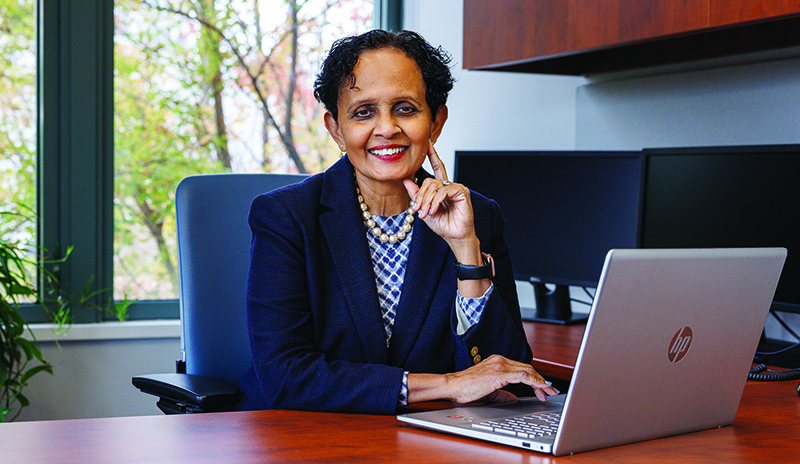
Two years ago Uma Gupta, director of the business analytics program, offered to teach a course on artificial intelligence because she saw a giant wave approaching. She wanted to help her students learn to surf it so they wouldn’t be overwhelmed.
But Gupta also is concerned about those who don’t seem aware of the changes that are coming, or who are unwilling to accept them. “We are heading into a society where you know AI or you don’t know AI, and that will be the wedge that will separate us,” she says.
This fall, with a Fulbright Canada award to aid her, Gupta wants to find ways to bridge that gap.
As a Fulbright distinguished research chair at Carleton University in Ottawa, Canada, Gupta will be spending the academic year researching strategies for upskilling and reskilling workers in AI. Her focus will be on industries where knowledge of, and proficiency in, AI is expected but not at a highly technical level.
“AI belongs to the self-learners, the continuous learners, those who view learning as play and fun,” Gupta says.
She applied to do her research in Canada in part because the country has invested heavily in AI research with many centers that have attracted top global talent. But paradoxically, Canada lags behind the US in AI adoption rates, particularly among small and mid-size businesses.
“So I started to get into the psychology of technology adoption, why some people love to get in and play in the pool, as I call it, and others are like, I’m not stepping into that ocean,” she explains. “What should we as an organization, as a society, do to bring everyone along?”
Gupta plans to develop practical proposals that can connect skills-based learning with specific jobs. She notes that with so many certification programs popping up everywhere, it can be confusing for people to know where to start.
“There’s a lot of chaos about ‘what should I learn?’” Gupta says. “‘If I do get the certification, am I going to get this job? What exactly does it mean?’”
Her hope is to create a clear pathway from training to a career so a worker gains the skills that a potential employer is seeking. Those pathways don’t have to come from universities, either – in fact, Gupta believes other platforms such as YouTube are likely to be nimbler in responding to evolving employment needs brought on by rapid changes in AI.
The main thing Gupta wants people to understand is that anyone can acquire basic knowledge of AI, as long as they’re willing to keep experimenting. “Just jump in and learn,” she says. “Some things will be boring, some things will be frustrating. If it is, you either push through if it’s important, or learn another course from somebody else.”