Students find community and purpose in Upstate’s ASL program.
When senior Cayden Nixon was young, the school nurses noticed a curious thing.
Sometimes she would pass her hearing tests, other times she wouldn’t. So the summer before she entered seventh grade, her parents took her in for a full hearing exam.
It turned out Nixon had single-sided deafness and she had adapted by relying on her right ear. The diagnosis spurred Nixon’s interest in ways to communicate that didn’t rely on hearing. She began teaching herself basic American Sign Language by watching videos on YouTube. In her junior year of high school, she joined the new ASL club.
By the time she reached her final year, Nixon knew she wanted to go to a college that had an ASL program. Her searches led her to USC Upstate.
Since the ASL minor was rebuilt three years ago under the leadership of associate professor Lana Cromeenes, it has surged in popularity, going from six students to more than 40. The rise reflects a national trend at colleges and universities, where ASL is the third fastest-growing language program, after Korean and Biblical Hebrew, according to the Modern Language Association.
It’s a rare bright spot amid nationwide declines in the study of languages other than English. Some of that growth is likely driven by media, Cromeenes says. “Big-name companies like Chick-Fil-A and Subaru now have some ASL commercials, and people think that’s kind of cool,” she notes. “It’s always been there, it just hasn’t been marketed.”
Esther Godfrey, who chairs the department of languages, literature and composition, has observed the increased interest in ASL at professional events she’s attended. “The deaf community is doing a great job with outreach and promoting visibility,” she says. “Deaf people have always been here and been among us, and we haven’t been respectful or understanding of that culture.”
The ‘Big Three’
One of Cromeenes’ goals when overhauling the ASL program was to give students a deeper appreciation of deaf culture. The issue is a personal one for her. Her daughter was born hard of hearing and Cromeenes was embraced by the deaf community when she turned to them for help. Her experiences inspired her to become an ASL interpreter and eventually earn a master’s certificate from Gallaudet University, the private school for deaf and hard-of-hearing students in Washington, D.C.
“I get asked all the time, how did you choose deaf, and my response is always, ‘I did not choose deaf, it chose me,’” says Cromeenes. “It was destined to be in my life, and I don’t mind it at all. I love it, actually.”
Students who take her ASL classes immediately learn the “big three” principles that guide the environment they are entering: all-inclusive, barrier-free, and non-threatening. “I don’t tolerate anything but that, and excellence in that, and the bar is very high,” Cromeenes says.
That teaching philosophy resonated with senior Arden Mountjoy when she first enrolled in ASL. A psychology major, she became friends with Nixon her freshman year and learned about the ASL program through her. Intrigued, Mountjoy decided to take a class her sophomore year to fulfill her language requirement. She was hooked by the end of the first week.
“I realized that’s the kind of environment I want to be in, that kind of culture of acceptance and culture of support,” she says.
Learning by doing
Signing begins on day one in Cromeenes’ classes. Students find a partner and learn how to introduce themselves in ASL. Cromeenes starts every introductory-level class with “hot topics.” Sometimes it’s a basic question, such as “how do you feel today?,” that can be an opportunity to learn new vocabulary. Other times it might be a current event, giving the class a chance to discuss real-world issues related to the deaf community.
“By having them be critical thinkers and reflective thinkers, that has just naturally opened them up,” Cromeenes says. “‘Who am I as a world citizen? What’s my perspective of the world?’”
Jasmine North ’25 admits that when she signed up for introductory ASL, she was looking for an “easy” language to fulfill her requirement. She thought she’d take one year, maybe two, but like Mountjoy, she fell in love with the language.
A criminal justice major, North says the fast pace of the class was a challenge at first. But every time she got lost, Cromeenes would stop and do the signs with the class to help them understand. North also began catching on to ASL’s sentence structure, which does not use articles and is more abbreviated. “I was like, OK, I can do this,” North recalls thinking. “I actually enjoy doing this. This is awesome.”
Building bridges
Cromeenes spent her first two years building up relationships with the South Carolina School for the Deaf and the Blind, with the goal of creating more interactions between her students and the deaf community. Once she felt her students had mastered enough skills, she began inviting School for the Deaf classes to campus for basketball games and theater performances at which Upstate students interpreted.
Kaylynn Wright ’24, a theater major with an emphasis in production and a cognate in ASL, helped Cromeenes set up the performance interpretations. “It was kind of a big deal for me to smush my two sides together,” she says.
She and other students would practice with a script in advance of a show using a technique called glossing, where English sentence structure is adapted into a written version of ASL structure. Depending on the complexity of the show, glossing and revisions can take several months.
Wright, who now works as an entertainment technician at Disney World, says deaf-accessible events help create the nonthreatening, barrier-free environment Cromeenes advocates for in the classroom. “It applies to every space that we’re in,” Wright says.
A welcoming space
Students have also been proactive in creating community among themselves. Early in Cromeenes’ tenure, a transfer student approached her with the idea of creating an ASL club. Cromeenes had her hands full with the program, but she told the student, “You tell me what you want, and I’ll help you get there.”
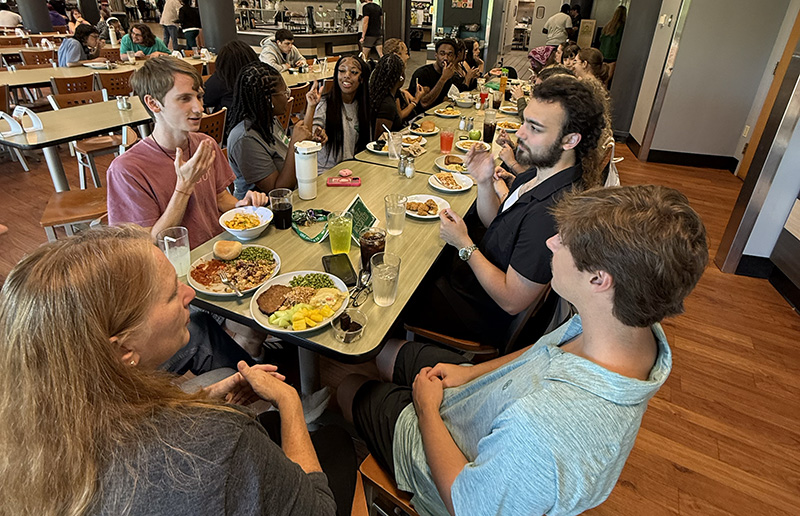
The club put together a small board and began looking for ways to get involved in campus events. That now includes building awareness of ASL through holding silent lunches in the cafeteria to practice signing and participating in Upstate Global Fest and the suicide prevention awareness walk.
Among the club’s most popular social activities are outings to Rossi’s Delicias. The restaurant is owned by the family of Joelle Mariano-Ramos, a sophomore biology major. Her uncle, who is deaf, works at Rossi’s and the class enjoys signing with him during their visits.
“The most meaningful thing for me is how excited my uncle gets when everyone is able to talk to him and communicate with him,” Mariano-Ramos says. “Because I understand that being deaf sometimes can make a person feel isolated. Now he feels like he can reach out to people more.”
The experience has also strengthened the bonds among her peers, Mariano-Ramos notes.
“When everyone comes to the restaurant, I feel a great sense of community with all of us together,” she says. “It’s fun when we can go out and reach out to deaf people and say hey, we’re here.”
Bonding experience
Because community is central to deaf culture, it’s at the heart of Cromeenes’ teaching philosophy as well. When students enter her class, she tells them, “We’re going to have a sense of belonging. We’re going to all be valued. We’re all going to communicate and learn to communicate. We’re going to work together.”
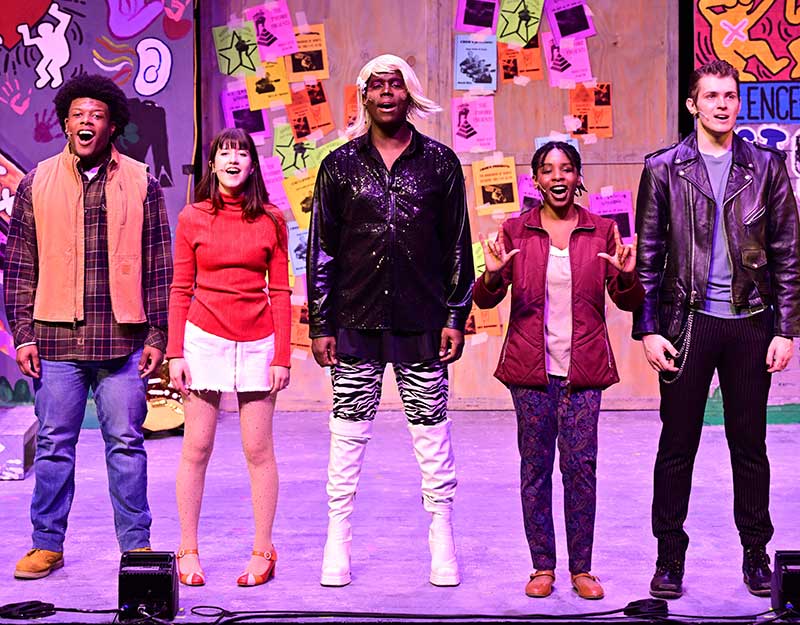
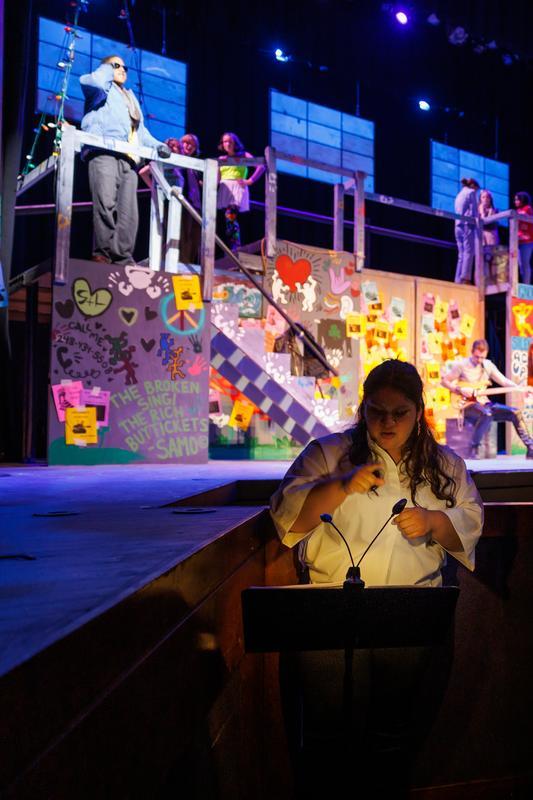
That came into play especially strongly this past spring semester, when upper level ASL students interpreted an Upstate Theatre performance of “Rent.” The large cast of characters and fast-paced singing required three months of preparation.
“It was stressful and it was very hard,” North recalls. “But ‘Rent’ brought a lot of us together. It created a community because we were all going through the same thing.”
For the first time, the ASL program also had a student in the show. Nixon decided she would sign her part while also singing and acting. While she has been doing theater since eighth grade and had signed while singing in her high school chorus, the communications major says combining all those skills took practice. In those scenes where Nixon was positioned away from her hearing side, a cast member would tap her on the shoulder to cue her. “It was a lot going on in my head,” she says.
Cromeenes’ first three years have included other firsts, too. Last year North was one of the program’s first two ASL interns. One student interned on campus and helped with marketing and social media for the ASL Club, which now includes more than 100 members. North interned off campus with the School for the Deaf and the Blind, where she assisted both blind students and deaf students.
Because the school’s library was undergoing renovations, she and her supervisor would bring books to check out to the deaf students’ dining hall. “The best part was when the older students would just come to our table, sit down to start eating lunch with us, and we would just be having a whole conversation,” she says. “And I’m like, oh my goodness, I understand what you’re saying.”
Planning ahead
As the program enters year four, Cromeenes already has plans for what comes next. Because she and her colleague Sydney Benton are both adjunct professors, and Cromeenes still teaches at the USC Columbia campus, she has successfully advocated for adding more ASL faculty. This year, two more instructors will be joining the program, one who will be teaching through Palmetto College and another who will be doing a flex class.
Also new this year will be a spring break trip to Gallaudet University. Cromeenes knew at the start she wanted her students to have the same kind of immersion experience that many foreign language students enjoy. But she also wanted to be sure they were prepared for it. Now that several students have completed at least one year of ASL, there are enough who feel comfortable using only ASL for a week, she says.
Examining the experiences of non-White deaf Americans is a priority for Cromeenes, too. Last year some of her bilingual students became involved in interpreting between English, Spanish and ASL, to improve communication between Spanish-speaking families, their deaf family members and non-Spanish speaking people.
This year Cromeenes is exploring a partnership with the Center for Africana and African American Studies that would focus on Black deaf in America. While Cromeenes doesn’t know Black Sign Language, she encourages her students to learn about the history of BSL. To that end, she has added books to the library on the topic and is seeking other ways to increase awareness.
Cromeenes is motivated to help the program grow and thrive for the sake of both her students and the deaf community. In her research with Benton for a book on the experiences of deaf Americans, Cromeenes found they repeatedly expressed a desire for good communication, being valued and a sense of belonging. “Basically what all humans want,” she says.
Not surprisingly, college students especially crave community, and that’s what ASL provides. “All I’m doing is bringing human connection and a sense of belonging,” Cromeenes says. She tells students, “You’re building a community and you’re important. We need you in that community because then you’re going to invite someone in.”
Life-changing moments
Alums and students say they have been profoundly affected by their experiences in the ASL program. They speak warmly of the friendships they’ve made and the purpose they’ve found in connecting with the deaf community. Perhaps just as significantly, they also credit ASL for helping them grow as people.
“If you would have met me at the beginning, there’s no way that I am going to stand up in front of a whole bunch of people and interpret,” North says.
But, she adds, “the things you think that you couldn’t do, you’re doing.” She now plans to pursue certification as an ASL interpreter, perhaps at Gallaudet, to “help the deaf community in any way that I can.”
For Wright, the theater graduate, the knowledge and fellowship she gained in the program were a source of support when an accident her junior year left her hard of hearing. She knew what accommodations were available to her and how to advocate for herself. And her studies on the history of deaf people reminded her “I’m not alone in what I’m going through.” Wright is setting up “deaf nights” at work for those who want to learn or practice ASL.
Nixon, now the ASL Club president, says she struggled for years to accept her hearing loss and would try to hide her partial deafness. Then one day, when students were introducing themselves at the start of one her classes, she found herself saying, “Hi, I’m Cayden, I’m hard of hearing and I’m a student here at Upstate.”
“That was the first time I ever introduced myself as hard of hearing in a public space,” she says.
Nixon realized saying the words out loud were a release and a revelation. She didn’t need to worry about being an outsider because she already had a place where she belonged.
“I realized I’ve been missing out on so much of my own culture and history because I wanted to present myself in a certain way, rather than just allowing myself to say, OK, I know I can’t hear out of one ear,” she says. “What can I do about it, except learn how to adapt. Learn how to work in this world.”